

Biblical Theology and Systematic Theology...and the Human Body
What does Anatomy Teach us about Theology?

The following is the first of 2 posts on the difference between Biblical Theology and Systematic Theology. The forthcoming post will be a little more systematic (no pun intended) in looking at the topic. This is my attempt to frame the question in a unique, hopefully helpful way.
Studying the Bible is a marvelous thing, a miraculous thing in many ways. It doesn’t take many re-readings of a chapter or book to realize that you are noticing “new” things each time, even that the very same Word is diagnosing you differently from one meeting to the next. This interaction with Scripture illustrates, for many believers, the truth of Hebrews 4:12: “For the word of God is living and active, sharper than any two-edged sword, piercing to the division of soul and of spirit, of joints and of marrow, and discerning the thoughts and intentions of the heart.” This isn’t just true when I re-read John’s Gospel, again and again, but also when I notice how John’s Gospel interacts with the book of Genesis, for instance. The truth of God’s Word seems to develop before me as I continue to read.
At the same time, the truth of God’s Word is unchanging. The Canon is established. We dare not add or subtract from Scripture. This means we can read the works of earlier generations of Christians and recognize the same faith. They read the same Word. We can even receive a statement like the Nicene Creed, benefit from it and employ it for our generation. That’s not to say that there is nothing else to say about the Trinity or the divinity and humanity of Jesus, but it is to say that Biblical thought can be, and has been, collected and articulated in a timeless way that benefits all believers, everywhere, all the time.
For those familiar with discussions around Biblical Theology and Systematic Theology, the above examples highlight some of the differences and unique contributions between these fields. Biblical Theology highlights the unfolding narrative of God’s redemptive work, noticing how the various parts of Scripture work together to tell one big story. Systematic theology illustrates the logical categories addressed by Scripture. The former develops over time as Scripture informs Scripture, event by event, and character by character, year after year. The latter is a work of classifying the totality of Biblical teaching on a category brought to the Word. There are some wonderful chapters and articles unpacking the unique contribution of each field to the Church.[1]
What I want to do here is a bit different. I want to provide a picture, a metaphor for these two fields, their purposes and practices. I want to do this because I think it will help those still struggling, in particular, to understand what Biblical Theology is. It’s not odd to hear something like:
1. I love Biblical Theology, and I’ve taken a class in it, but…
2. I’ve done a bit of work on Biblical Theology, and I think I get it, but…
3. I’m putting together a class for my church on Biblical Theology, but…
“I’m still struggling to really define it.”
This struggle is amplified, in part, because works attempting to introduce Biblical Theology often highlight the difference in methodological approaches more than helping the novice truly grasp the nature of Biblical Theology to begin with. Before our definition is clear, our heads are swirling with names like Gabler, Barr, Vos, and Beale, or with methodological challenges like criticism, theological unity, and intertextuality. While we want to deal with such issues eventually, I wonder if a metaphor might be a better way to help the neophyte get their bearings. The metaphor I want to use is the study of the human body.
There are many ways to approach understanding the human body. The first that most of us will encounter is what I will call an approach through taxonomy. When asked to describe the body, the taxonomist might answer, “Well, the body is composed of eleven systems: integumentary, skeletal, muscular, lymphatic, respiratory, digestive, nervous, endocrine, cardiovascular, urinary, and reproductive.” This is an accurate answer. It has taken the complex parts of the body and classified them based on shared location or function. It is a systematic approach.
And it is an indispensable tool in the belt of the doctor or nutritionist, for example.
It’s also an easy way for a student to start to understand the major facets of the human body. I recall spending hours with our ancient set (circa 1985) of World Book encyclopedias growing up. One of my favorite sections to explore was the set of transparent overlays in the middle of the “H” volume. Its base was the human skeletal system, but you could add layer after layer of body systems to the image simply by folding over the next clear overlay sheet. Altogether, with the skin finally added, you have the whole body. For those that need more specialized systematic education, courses like histology will categorized all the tissues in the body and courses like cardiology will further unpack the relationships between the heart, veins, capillaries, etc. This is one way to study the body.
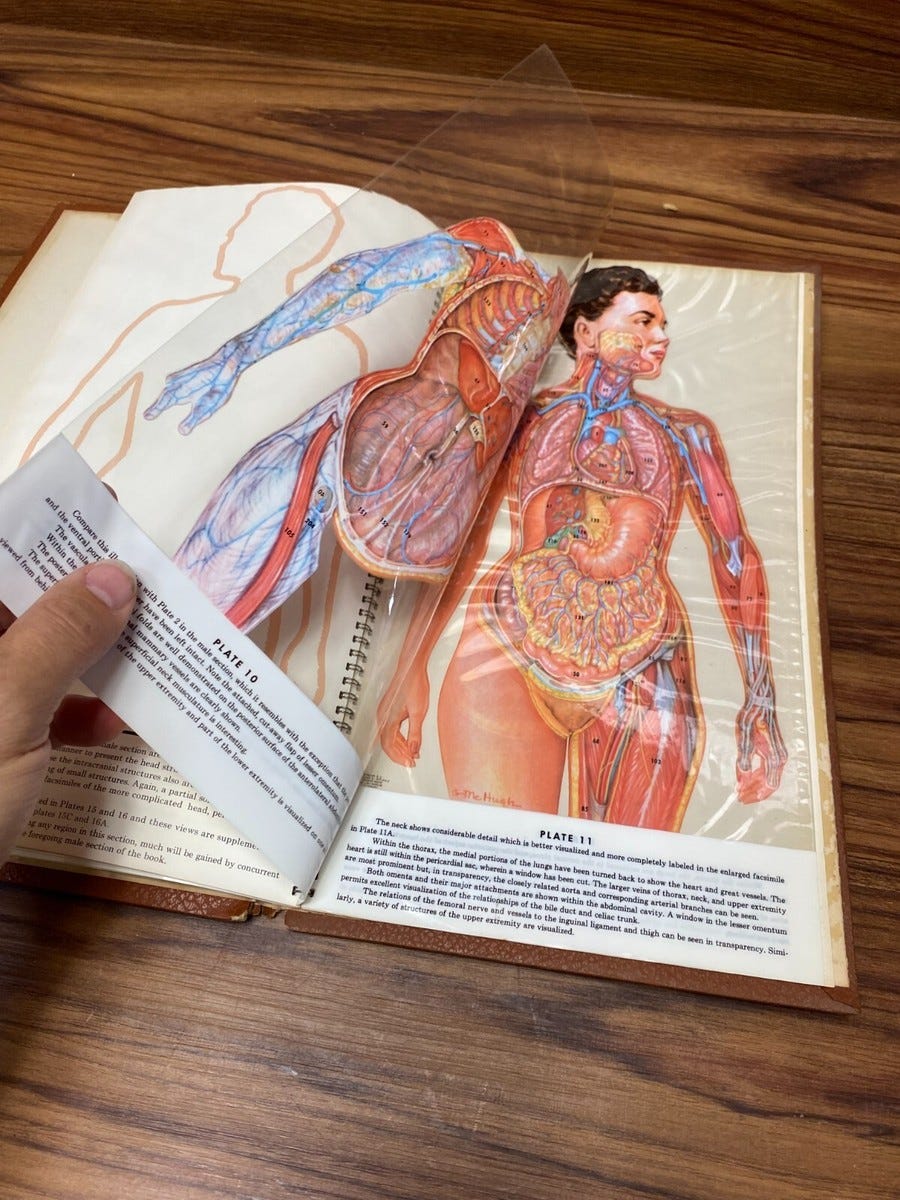
Another way to study the body, however, is to understand how the body develops and works. The physical therapist must study the skeletal and muscular systems for instance, but not just for classification. No, they must move on to understanding how each part of the system works and relates to other parts. They understand the pieces, but also the whole. With observation, they notice that a muscle is able to move a bone because of the connecting tendon. They may see that the bones are kept stable through strategically places ligaments. Where these pieces come together, what we call joints, are systems within themselves working on their own and connected to other parts of the body. As the song goes, “the foot bone’s connected to the…leg bone!”
As the body develops over time, each system grows. When each is functioning properly, you have a healthy person. Studying the body in this way isn’t better than the previous, but it is different. They both rely on observing the parts and the whole, but they tell you different things about what a functioning human is all about. They speak to each other, inform each other, but they are different. Checking a pulse can tell you that someone is alive, observing a human in action, shows you what life is about…how it works.
Let’s apply this to Systematic and Biblical Theology. Systematic Theology – let’s take ecclesiology for the moment – helps us understand the Biblical necessities of a church, the gathered people of God. Biblical Theology, instead, observes the process of the living God going about electing, creating, and redeeming his people from Genesis to Revelation.
Soteriology helps us rightly order the links in the golden chain of redemption, and Biblical Theology narrates how Christ the bridegroom defeats his arch-enemy in order to win a bride for himself.
A statement of faith or a Christian confession may beautifully and systematically describe the Triune nature of God. Biblical Theology narrates the story of God the Father, Son, and Spirit creating and redeeming humanity in space and time.
Taking our medical examples in hand, Systematics defines the cardiovascular system – what it is, is not, does, and does not do. Biblical Theology, on the other hand, is able to trace the flow of blood from the left ventricle out through miles and miles of blood vessels to bring life to the entire body and back again to the right atrium, taking note of the give and take of arteries and veins, and even recognizing the role of tiny capillaries in the larger body. It helps us understand the parts and their role in the whole. Systematics recognizes that these pieces are all part of the cardiovascular system, while Biblical Theology might alert us to the centrality of the heart within the system.
And like a good physical therapist, the Biblical Theologian notices connections. How does Isaiah rely on Moses or Paul on Habakkuk? How does Christ and the apostles use/read/interpret/apply the Old Testament? Where is continuity and discontinuity between the Testaments? Is there a clean break between the Old and New, or are their miles and miles of vessels, tendons, cartilage, and ligaments connecting the two? Is the same heart pumping blood through the Torah as through the Gospels? Is the same Mind (i.e. nervous system) behind the redemption of Israel and the Church, or are there two plans of salvation for two peoples?
Both approaches are biblical. Both are helpful. But they are different. I hope this has helped you see and appreciate the difference.
What about you? How have you thought about the differences between Biblical theology and Systematic theology? What’s a resource or two that you point people to?
[1] Such as DA Carson’s, “Systematic Theology and Biblical Theology,” in The New Dictionary of Biblical Theology. Downers Grove: Intervarsity Press, 2000 and Oren Martin’s, “How do Biblical Theology and Systematic Theology Differ and Work Together?” in 40 Questions about Biblical Theology. Grand Rapids: Kregel, 2020.